
When Rochelle Sweet-McCullough started her college education in 1987, she never would have guessed the small school she attended for two years before starting a family would later become one of the largest universities in the country. Twenty-five years later, Sweet-McCullough returned to finish her degree and witness Kennesaw State University establish itself as a well-respected four-year institution.
“It was night and day,” Sweet-McCullough said. “All of the sudden, we saw dorms coming, and a building where you could eat. The college green began developing [and] getting Scrappy the owl . . . it was just amazing.”
This year marks 13 years since Sweet-McCullough returned to KSU in 2012 to complete her college education. She said that even in 2012 she saw KSU’s growth underway.
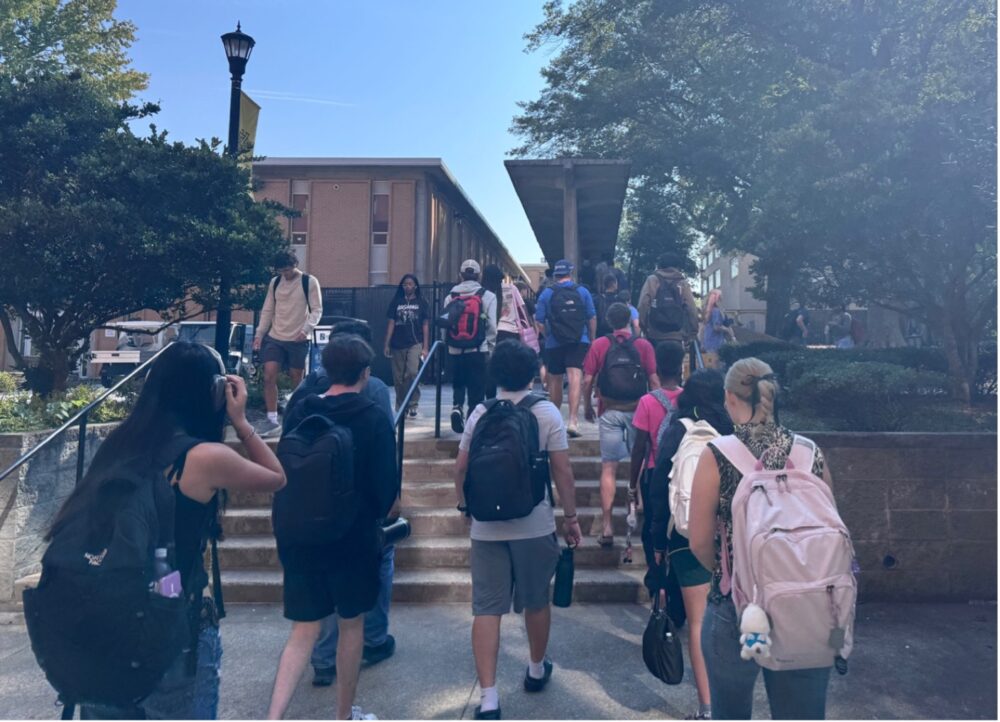
In August 2025 KSU admitted 12,381 new students to its freshman class, “Flight 29,” a glaring contrast to Sweet-McCullough’s 2012 freshman class of 6,107 students. The incredible population growth of the last 10 years has brought frustrations for both new and current students due to the severe lack of parking, overcrowded campus life and shrinking space on campus and in surrounding areas to KSU, affecting both the school and the community.
Students such as sophomore chemistry major Rhianna Allen say they notice parking on campus is nearly impossible. The overcrowding of students is mirrored in the classrooms as well, Shahzain Jiwani, a mathematics major, said.
The total population of KSU in Fall 2025 is 51,375 students. It is now the third largest school in Georgia, and was named the 7th fastest growing university in the United States. Among the other large Georgia universities, Kennesaw State’s undergraduate population of 46,069 students is larger than both Georgia Institute of Technology and the University of Georgia (UGA). This Fall Georgia Tech welcomed a freshman class of 4,050 students out of an undergraduate population of around 20,000 students, while UGA welcomed 6,200 students out of its total of 32,399.
Georgia State University (GSU) and KSU have similar enrollment numbers. GSU has around 48,000 undergraduates compared to KSU’s 46,069 undergraduate students. Both Georgia Tech and Georgia State University had student populations of more than 50,000 in previous years, but KSU surpassed both universities in freshman student enrollment numbers this fall, with a 7.4% increase in enrollment between this year and last.
KSU was a hot topic on social media in recent months regarding its large student population. A surge of popularity on TikTok placed the school under a spotlight, inviting scrutiny that reaches communities outside of Georgia. Rants about parking complaints, videos of crowded campus events and students shown sitting along the back wall of classrooms without desks, are just some of the ways college students express their frustrations. These were just a fraction of the more than 124,000 TikTok videos with the hashtag KSU. Allen said the ‘influencer’ culture at KSU is contributing to the massive boost in admission the university is facing.
Students say they are skeptical about the ways the university handles the problems that come with the surge in population and online attention the school receives.
Fresh Take Georgia contacted admissions personnel at KSU. They declined an interview.
“KSU needs to admit there is an issue,” Jiwani said. “The fact that [KSU is] not acknowledging the issue makes it feel to people they’re not going to try and resolve [it].”
Sophomore Rhianna Allen also said the school may be attempting to sweep some of these problems away, so it can continue admitting more students without proper infrastructure to accommodate them. The lack of accountability from the institution has been discouraging for her.
“I don’t like how KSU is handling a lot of the issues that it has. [The faculty] being like ‘hey, this actually isn’t happening’. . . makes people who attend [the school] see them in a different light,” Allen said.
“[There] are very true parallels when we talk about Kennesaw State. One, recognizing there comes a point where you’ve got the abundance you’re looking for and you’re healthy and it’s vibrant and this kind of depth on enrollment. . . allows you to make good intelligent personnel decisions and start to commit some resources,” Chris McCollough, director of the School of Communication and Media, said.
Out of all of the public universities in the state in 2024, KSU was the Comprehensive University with the highest value-added impact number at $1.6 billion . Value added impact means the overall economic benefits to local businesses and residences. KSU alone accounted for a little more than half of the total Georgia Comprehensive University economic output impact in the fiscal year (FY) of 2024. The university generated $2.3 billion out of a total of $4.5 billion added to Georgia’s economy, according to the June 2025 report by the Terry College of Business at the University of Georgia.
“The counterpoint is, if you’re deciding that [this is] the cap out [on population], you have to remember that the state system we’re in runs on a growth budget. So, state schools and how they’re budgeted each year are measured against how they do on their growth markers and their prosperity. So, where we are is a welcome position for most USG institutions because we have the ability to pull students in and continue to grow, where a lot of them have had to struggle to sustain,” McCollough said.
“I can understand the student perspective being frustrated. It’s the balance of something that’s a tremendous opportunity in front of us,” McCollough said. “The corollary [to this opportunity] is, you’re going to have [these] growing pains,”